
Do Hashtags Still Work? The Ultimate Guide for Creators

sushakanaujia
Author
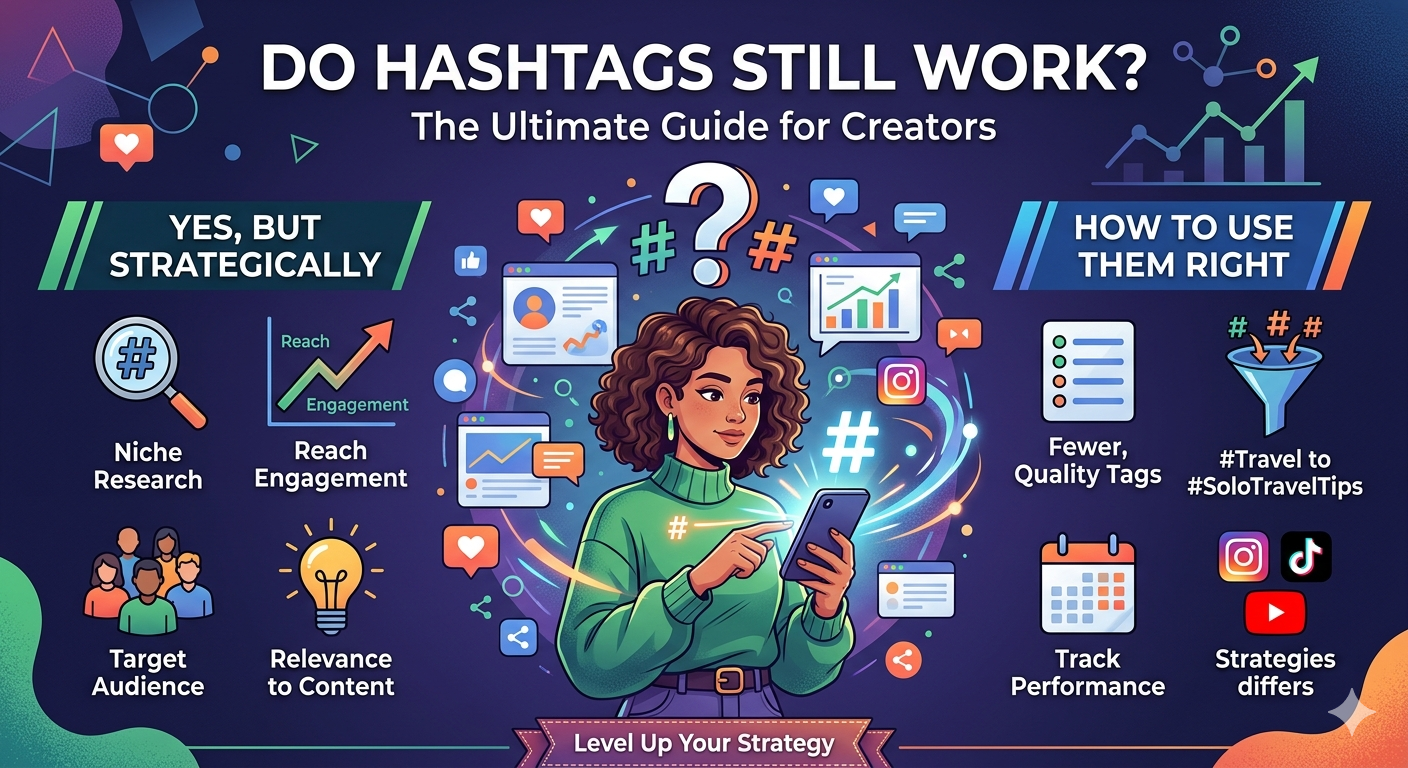
Spending hours researching hashtags, meticulously crafting captions, only to hear crickets? You’re not alone. The hashtag strategy has changed, and what worked in the past might not cut it in 2024. Are hashtags still relevant? Let’s find out.
Let’s face it: the world of social media marketing feels like it’s constantly changing. One minute, a particular strategy is gold, and the next, it’s about as useful as a screen door on a submarine. And social media hashtags? They’ve been a hot topic of debate for a while now. Are they relics of the past, banished to the social media graveyard? Or are they still a secret weapon for content creators looking to boost their visibility and increase engagement?
Some creators swear by them, claiming they’re essential for discoverability. Others roll their eyes, convinced hashtags are outdated and ineffective. So, who’s right?
This guide cuts through the noise and provides a data-backed, platform-specific hashtag guide to help you leverage hashtags effectively in 2024. We’re diving deep into the world of hashtags, exploring their past, analyzing their present, and predicting their future. Learn how to use hashtags to increase followers.
We’ll be covering Instagram, TikTok, YouTube, and X (formerly Twitter), examining their unique hashtag ecosystems and how you can tailor your strategy for each. Get ready to level up your social media game and grow your online presence!
The Evolution of Hashtags: A Brief History
Let’s start with the basics: what are hashtags for social media? Simply put, hashtags are keywords or phrases prefixed with a “#” symbol. They’re used to categorize content and make it discoverable within a social media platform’s search function. Think of them as digital labels that help people find content related to specific topics.
Believe it or not, hashtags originated on Twitter back in 2007. Chris Messina, a web developer, suggested using them to group relevant messages. Early hashtags on Twitter were used to organize conversations around events like #SanDiegoFire or #SXSW.
The idea quickly spread to other platforms, and before long, hashtags became a ubiquitous part of the social media landscape. But as social media platforms have evolved, so has the role of hashtags. Algorithmic changes have significantly impacted how they work. Understand hashtag analytics to improve your strategy.
- Instagram: Initially, Instagram’s feed was chronological, making hashtag feeds a real-time representation of content. Now, the algorithm prioritizes content based on user interests, engagement, and relationships. Hashtags still matter, but they’re factored in along with other signals like visual quality, related terms, and user interests. Learn how to optimize your Instagram hashtag strategy.
- TikTok: Initially, TikTok was primarily based on trending sounds and hashtags, with the algorithm heavily pushing content with popular sounds. Now, the algorithm prioritizes user’s interests based on prior engagement in the FYP (For You Page) and related content. While sounds are still king, relevant hashtags are crucial for defining the niche your content belongs to. Master the art of TikTok hashtags.
- YouTube: Originally, hashtags appeared only in the video description. Now, they appear directly above the title (up to 3). YouTube’s algorithm also focuses on keywords in titles, descriptions, and tags, but hashtags can help categorize videos for related content searches. Enhance your YouTube SEO with strategic hashtags.
Challenges and Downsides of Using Hashtags
Using social media hashtags isn’t always smooth sailing. There are a few potential pitfalls to watch out for:
- Shadowbanning: Using irrelevant or banned hashtags can lead to your content being hidden from explore pages. For example, using #followme on Instagram when your content has nothing to do with that topic could trigger a shadowban.
- Hashtag Abuse: Overusing hashtags or using them in a spammy way can negatively impact your content’s credibility. Nobody likes a hashtag bomb!
- Generic Hashtags: Can be too competitive, and your content will get lost in the mix. Think #love, #happy, or #instagood. Avoid these common hashtag mistakes.
Do Hashtags *Really* Still Work for Creators? (The Evidence)
Okay, so we’ve established what hashtags are and how they’ve evolved. But the million-dollar question remains: do they *actually* work in 2024? Let’s look at the evidence and determine the best hashtag practices.
- Data and Statistics: While the landscape is constantly shifting, data still points to the value of hashtags. A recent study by Hootsuite found that posts with at least one hashtag have an average of 12.6% more engagement than posts with no hashtags. However, the same study found diminishing returns after 3-5 hashtags. On TikTok, anecdotal evidence (from creator interviews) suggests that using trending hashtags can significantly boost views, especially for new creators.
- Expert Opinions: Experts in the social media world agree that hashtags are still important, but not the *only* piece of the puzzle. “Hashtags are still an important part of Instagram’s discovery process, but they’re not the *only* factor. Focus on creating high-quality, engaging content and building a community,” says Social Media Examiner. Influencer Marketing Hub suggests, “On TikTok, jumping on trending hashtag challenges is a great way to get your content seen, but make sure it aligns with your brand and audience.”
- Case Studies:
- Instagram: @wanderlust_travel used a combination of niche hashtags like #travelgram, #travelphotography, #beautifuldestinations, and location-specific hashtags (e.g., #italy, #rome) to grow their following to over 500k. They also used branded hashtags like #WanderlustAdventures to build their brand identity. Analyzing their posts, the highest-performing ones often featured location-specific hashtags with moderate search volume (10k-50k).
- TikTok: A fitness creator, @fitwithlisa, gained viral traction by participating in the #WorkoutFromHome challenge and creating content using the #fitnessmotivation hashtag.
- YouTube: A gaming channel focused on Minecraft. They used the following #Minecraft #Gaming #Tutorial #Redstone and created a branded hashtag #ChannelNameMinecraft to build their brand identity.
- Misconceptions:
- “More is Always Better”: Debunked. Spamming irrelevant hashtags can hurt your reach.
- “Generic Hashtags Always Work”: #Love, #Happy, #Instagood are too broad. You’ll get lost in the noise. Learn how to pick the right hashtags for your niche.
The Platform-Specific Breakdown: Mastering Hashtags on Each Platform
Alright, let’s get down to the nitty-gritty and explore how hashtags work on each platform:
A. Instagram:
- Algorithm: Instagram’s algorithm prioritizes content that aligns with user interests, based on past interactions. Hashtags help categorize content, but other factors (engagement, relationship to the user) are more important.
- Number: Aim for 3-5 highly relevant hashtags. Experiment to see what works best for your niche.
- Types: Niche, Branded, Community, Location, Trending.
- Research Tools: Display Purposes, Sistrix, Photerloo.
- Instagram SEO: Optimizing bio with keywords, creating keyword-rich captions with relevant hashtags, using alt text for images. Improve your Instagram reach with these tips.
B. TikTok:
- “For You” Page: The holy grail of TikTok! Hashtags are a crucial signal to the algorithm about what your video is about, helping it reach the right audience.
- Trending vs. Niche: Balance trending challenges with hashtags related to your specific content.
- Sound/Music: Using popular sounds is almost as important as hashtags on TikTok. The algorithm heavily prioritizes trending sounds.
C. YouTube:
- Placement: The first 3 hashtags in your description will appear above the video title.
- Impact: Hashtags help categorize your videos for search and related content suggestions.
- Branding: Use a branded hashtag for all your videos to create a searchable library of your content.
- YouTube SEO: Optimizing video titles, descriptions, and tags with relevant keywords, creating engaging thumbnails.
D. X (Twitter):
- Trending Topics: Hashtags are the backbone of Twitter’s trending topics.
- Real-Time Engagement: Use hashtags to participate in live events, breaking news, and trending conversations.
- Brand Monitoring/Campaigns: Create a branded hashtag for your marketing campaigns to track engagement and user-generated content. Utilize trending hashtags on X.
How to Find the *Right* Hashtags for Your Content: A Step-by-Step Guide
Finding the right hashtags is crucial for maximizing your reach. Here’s a breakdown of how to do it:
A. Keyword Research:
Use tools like Google Keyword Planner, Ahrefs, and Semrush to identify keywords related to your content and audience. Then, search those keywords on each platform to see what hashtags are commonly used.
B. Competitive Analysis:
Identify successful creators in your niche. Analyze their most popular posts to see what hashtags they’re using. Adapt their strategy to your own content and brand.
C. Platform-Specific Research:
- Instagram: Use the “Related Hashtags” feature when searching for a hashtag.
- TikTok: Pay attention to trending sounds and challenges on the “For You” page. Use the “Discover” tab to find trending hashtags.
- YouTube: Start typing a hashtag in the search bar, and YouTube will suggest popular related hashtags.
- X (Twitter): Check the “Trending” section on the left-hand side of your feed to see what’s currently popular.
D. Hashtag Research Tools:
RiteTag, Hashtagify, Flick.
Building a Winning Hashtag Strategy: Your Roadmap to Success
Here’s a step-by-step guide to building a social media hashtag strategy that actually works:
A. Define Your Target Audience:
Who are you trying to reach?
B. Know Your Niche:
What are the key topics and communities within your area of focus?
C. Create a Hashtag Bank:
Organize your hashtags into categories (niche, branded, location, etc.) for easy access.
D. Mix It Up:
Use a variety of hashtag types to reach different audiences.
E. Track Your Results:
Monitor which hashtags are performing best using platform analytics.
F. Stay Updated:
Social media algorithms are constantly changing. Follow industry news and experiment with new hashtags to stay ahead of the curve. Master the art of social media marketing hashtags.
Beyond Hashtags: Alternative Strategies for Reach and Engagement
Remember, hashtags are just one piece of the puzzle. Here are some alternative strategies for reaching and engaging your audience:
- SEO Optimization
- Community Engagement
- Collaborations
- Paid Advertising
- Email Marketing
- Content Promotion
FAQ: Hashtag Edition – Your Questions Answered
Q: Are hashtags dead on Instagram?
A: Definitely not dead, but their role has evolved. Instagram now emphasizes content aligning with user interests based on past interactions. Hashtags still categorize your content, improving discovery.
Q: How many hashtags should I use on TikTok?
A: There’s no hard and fast rule, but aim for a mix of 3-5 trending and niche-specific hashtags. Prioritize relevance over sheer quantity.
Q: Can using too many hashtags hurt my reach?
A: Yes! Overusing hashtags, especially irrelevant ones, can make your content look spammy and may even trigger shadowbanning.
Q: How can I find trending hashtags on TikTok?
A: Check the “Discover” tab or browse the “For You” page for trending sounds and challenges. Also, keep an eye on what other creators in your niche are using.
Q: What’s the difference between a niche and generic hashtag?
A: Generic hashtags are broad terms (like #love) that attract a massive but often irrelevant audience. Niche hashtags (like #vegancake) target a more specific and engaged audience.
Conclusion: Hashtags in 2024: A Powerful Tool When Used Strategically
Hashtags are still a valuable tool for creators, but they need to be used strategically and in conjunction with other strategies. They’re not a magic bullet, but when used correctly, they can help you reach a wider audience and grow your online presence.
The best hashtag strategy is the one that works for *you*. Don’t be afraid to experiment, track your results, and adapt your approach as needed. Social media is a constantly evolving landscape, so staying flexible and informed is key. Unlock your social media potential with the right hashtag strategy.
Now it’s your turn! What are your favorite hashtag strategies? Share your tips in the comments below!